

Behind the Scenes by John Miller – March 2025
Sometimes it’s all about timing. In 2002, the movie musical Chicago was released, winning six Academy Awards including Best Picture. The success of Chicago paved the way for a new generation of successful live-action musicals, most recently the critically acclaimed and popular movie Wicked. However there exists a vast wasteland between 1968, when Oliver won the Best Picture Oscar, and Chicago, where musicals languished at the box office, failing to appeal to audiences.
Newsies was released in 1992 and was a rare Disney flop that was pulled from many theaters after a disastrous opening weekend. A lackluster marketing campaign that tried to appeal to both children and adults was also to blame, but primarily it was bad timing. If Newsies had come out in the 2000’s it would have been a hit, and I can prove it!
After the box office failure of Newsies, it gained a new following on home video and even spawned amateur youth theater productions. This strong fan base eventually led to a Broadway musical adaptation. Opening in 2012 Newsies: The Musical was a hit featuring Tony award winning choreography and score and a compelling story based on the real newsboys’ strike of 1899.
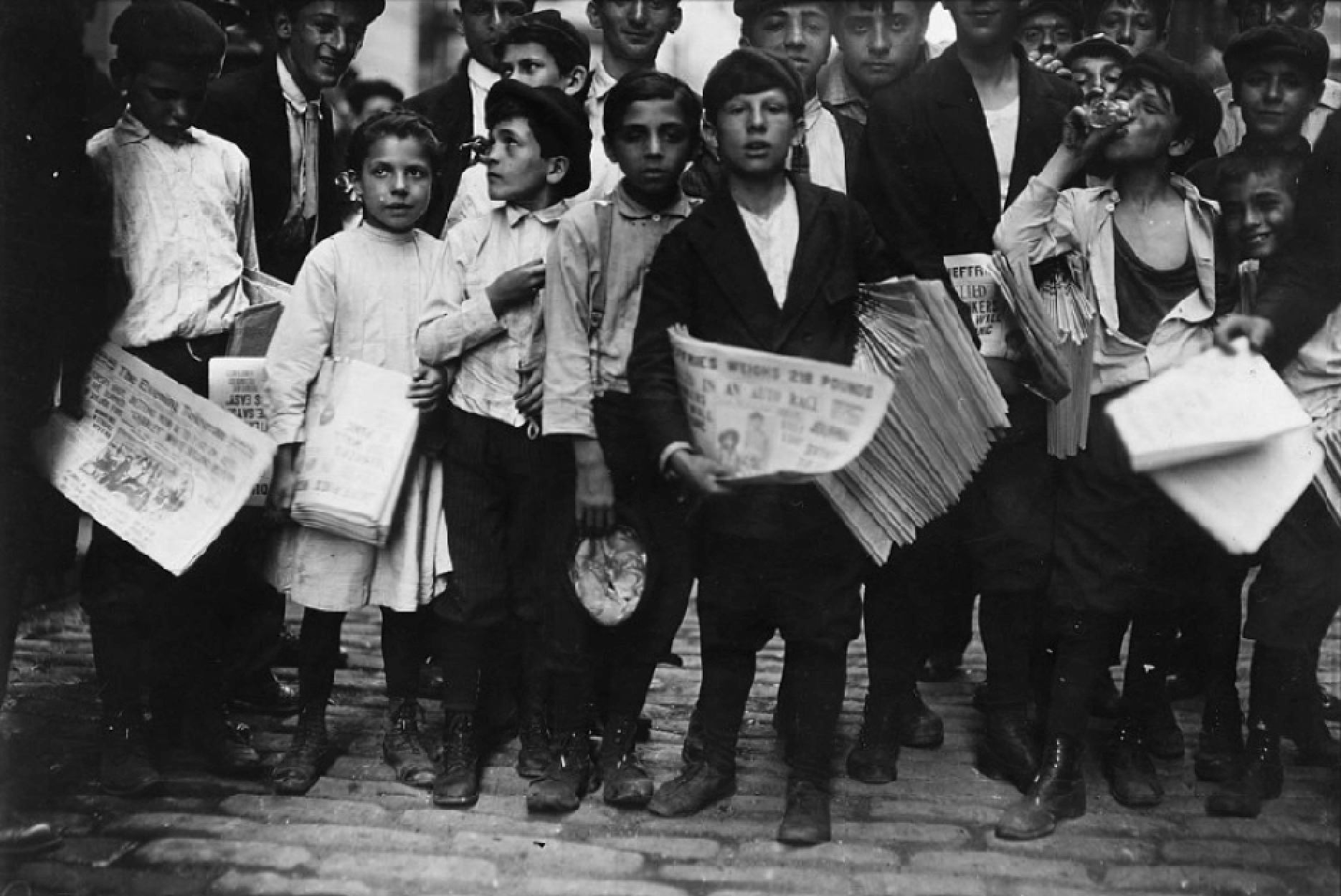
The Real Newsies
At the turn of the century newspapers had a morning edition delivered to subscribers but depended on newsboys for selling their afternoon editions. For 50¢ per hundred the newsboys would buy the papers from the publisher and sell them for a penny each, earning a half cent profit for each paper. These newsboys were often from poor immigrant families and sold papers in the afternoon and evenings after school, often working late into the night to sell all their papers.
In 1898 the advent of the Spanish American War created an increased interest in the news and many publishers raised their prices to 60¢ per hundred. At first the newsboys accepted the increase because extra sales made up for the increase. After the war ended most newspapers reverted back to the 50¢ price. But not Joseph Pulitzer’s World or William Randolph Heart’s Journal. The newsboy strike lasted for two weeks attracting the attention and support of the public. The circulation of the World decreased from 360,000 a day to 125,000. Eventually the newsboys and the publishers reached a compromise. While the price of papers remained at 60¢, Pulitzer and Hearst agreed to buy back unsold papers. Newsboys who had trouble selling their papers would not be forced to sell late into the night in order to turn a profit.
Add music and dance to that story and you’ve got yourself a musical!
Designing Newsies Jr.
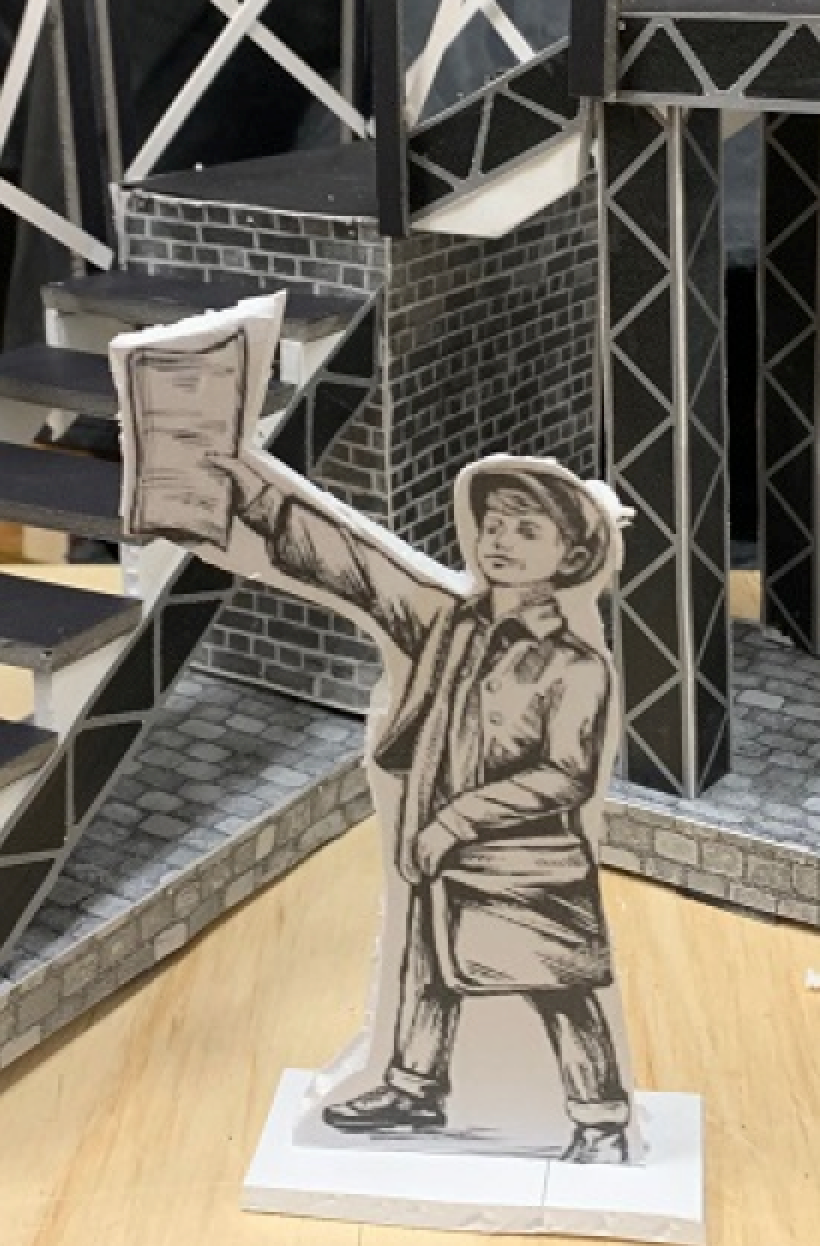
I began my design research by examining old photos of New York City and viewing both the original movie and the filmed Broadway production. The gritty, industrial look seemed very appropriate for the real-life origins of Newsies. Some of the key elements that stood out to me were cobblestone streets, brick buildings and steel bridge trusses.
My first big decision was whether to use scenic projections or not. We often use projected scenery in our Theater Arts productions, but I was uncertain how they would work with my vision for the set. Our usual projections are a bit cartoony, which is fine for Little Mermaid, but wasn’t what I wanted for Newsies Jr.
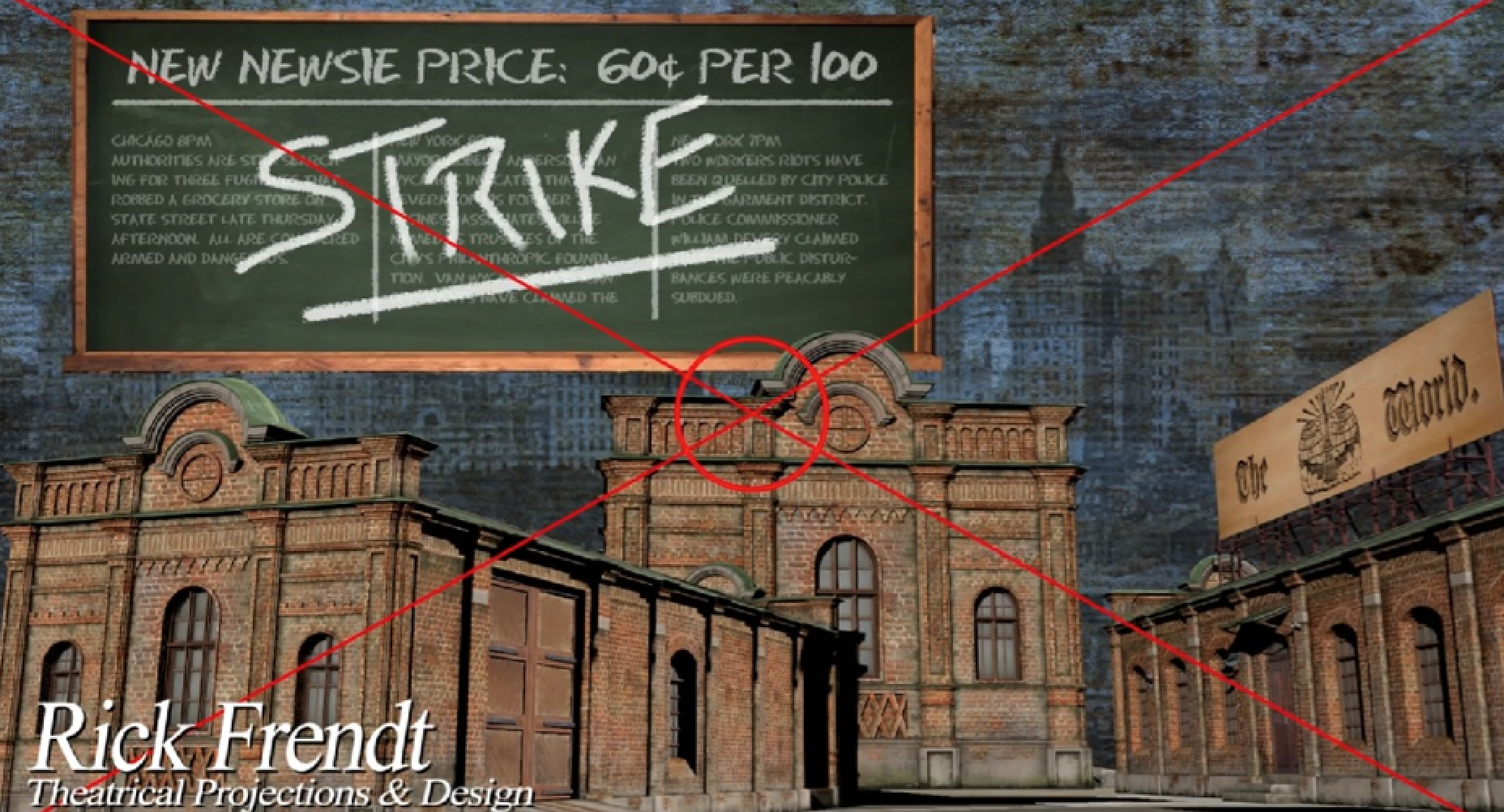
First, I thought we would rent a backdrop for the performance, a generic old city background. I looked at our usual sources and couldn’t find anything I liked. But then, a random Google search led me to Frendt Projections. Their projections for Newsies were somewhat stylized, but reflected that look I wanted to achieve in Newsies Jr. Upon confirmation with director Katie Smith our first set design decision was completed!
After deciding to use the Frendt projections it was time to think about the rest of the set. There are many locations, so the set needs to be flexible. There are 60 kids in the show, so the set needs to accommodate them, meaning extra levels. And the set needed to mesh with both the Frendt projections and my vision of a gritty 1899 New York City.
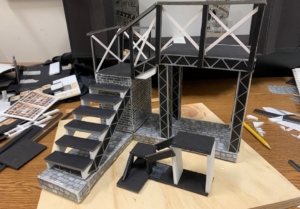
I came up with two large rolling units with stairs leading up to a raised platform. The platforms can be used together or separately as they are repositioned for the different scenes in Newsies Square, Medda’s Theater or Pulitzer’s Office. Putting together the two units will create a twelve-foot-long bridge!
I felt these units would be a challenge for Greg, our set builder. So I did something unusual… I built a model of the rolling unit in 1” scale. Normally I build set models in 3/8” scale, but it’s hard to show much detail at that scale. Greg was able to take the 1” scale model and use it to figure out how much lumber he would need and how to build it. He knocked it out of the park and didn’t have any problems building the set at all!
The other benefit of the 1” scale model was to show Katie all the different textures I was visualizing for the paint treatment. Katie leads the paint crew and she’s real excited that she gets to paint bricks again! (That’s sarcasm, by the way.)
I built the model in gray scale, but after the set was painted there was blue/gray cobble stones, reddish brown bricks, green railings and metallic truss work!
I’m excited about my lighting ideas for Newsies Jr. We just purchased a new hazer which creates an atmospheric fog so beams of light really pop out. It creates stunning effects when you add gobos in your lights and aim them through the haze. I’m even ordering some new gobos that will look great with the haze!


I’m toying with the idea of not using deep colors in the lights, either no color or light blues and browns. One of my favorite gel colors is Rosco 99 – Chocolate, it’s great for a sepia toned effect, perfect for Newsies Jr. Lighting ideas can change a lot during tech week, so we’ll see what happens!
I hope I’ve not given too much away and only whetted your appetite for an upcoming production of Newsies Jr.
[Editor’s note: This article was written by John Miller, Technical Director at the Reif Performing Arts Center in Grand Rapids. It is part of a series of monthly articles titled “Behind the Scenes”. All of his articles are available on the Reif Center’s website at https://www.reifcenter.org/reif-behind-the-scenes/. MACT would like to thank John and the Reif Center for allowing us to reprint this article. The Reif Center will be the location of MACT*Fest 2027.]