By Steven LaVigne
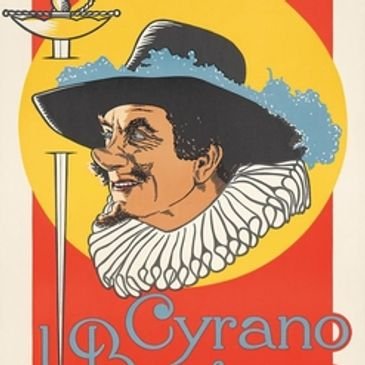
French playwright Edmond Rostand’s romantic tragicomedy Cyrano de Bergerac was first produced in 1897 and has been in the world theater repertoire ever since. It’s been filmed, most famously with Jose Ferrer in 1950, for which he was honored with an Oscar. Other actors who took on the role are Gerard Depardieu, Kevin Kline and Peter Dinklage. French composer Franco Alfano, and librettist Henri Caïn, created an opera based on the play and there have been a couple of musical versions, one of which was first produced at the Guthrie Theater starring Christopher Plummer.
Did you know that there really was a Cyrano de Bergerac?
That’s right. He wasn’t just a character with a big nose on stage and screen. Hector Savinien de Cyrano de Bergerac (1619-1655) was a renaissance man. Born in Paris, he came from a noble family. His father was a lawyer, and from an early age, he showed a restless spirit and a sharp mind, characteristics that would become necessary in his life. He wrote science fiction novels, plays and was a famous duelist. Born in 1619, in his novels, Comical History of the States and Empires of the Moon (1657) and The States and Empires of the Sun (1662) are classics of early modern science fiction. Two centuries before H.G. Wells and Jules Verne, Bergerac wrote about space travel and people living on the moon. His writing was influential to such writers as Poe, Voltaire and Jonathan Swift. Moliere was even accused of plagiarizing de Bergerac’s work.
In Paris, where he studied at the college de Dormans-Beauvais, he wrote his first play The Pedant Tricked. When he was 19, he entered the corps of the French Guards, where he fought in the Siege of Arras during the 30 Years’ War. Bergerac gained fame for both dueling and boasting about it. However he was wounded which ended his military career. Among those he fought with was Baron Christian of Neuvillette, who married Cyrano’s cousin Madeleine Robineau. She lived with Bergerac’s sister, Catherine at the Convent of the Daughter of the Cross. The romance presented in the play was created by Rostand.
Following his injury, he moved to Paris and began writing classical tragedies. The young man’s writing questioned tradition. He debated that reason and observation should guide understanding, thus becoming a pioneer whose concepts would help shape the Enlightenment.
Because Rostand’s play focused on his romantic life and the size of his nose as a symbol of his wit and courage, the play simplifies the complexities of his life. Bergerac was a multifaceted individual who contributed to literature, philosophy, and science. His real life was filled with challenges. He struggled with financial difficulties and faced criticism for his unconventional ideas.
The actual circumstances of Bergerac’s death are unknown, however there’s a theory that his death was the result of a botched assassination attempt and by failing health after a period of confinement. Bergerac died on 28 July 1655, He was buried in Sannois.
Theater audiences will have the opportunity to see Edmond Rostand’s masterpiece when Classics Lost ‘N’ Found Theater Company presents Gertrude Hall’s translation onstage at Lake Nokomis Presbyterian Church, 1620 46th Street East in south Minneapolis.
The production is being directed by Gregory Bastien and there will be seven performances: Fridays and Saturdays April 17-18, 24-25 and May 1-2 at 7pm, with a 2 pm matinee on April 26th.